Weather Data Integration Transforms Golf Wagering Approaches at British Venues
Written by Rosa Franke · May 28, 2026

Weather Data Integration Transforms Golf Wagering Approaches at British Venues
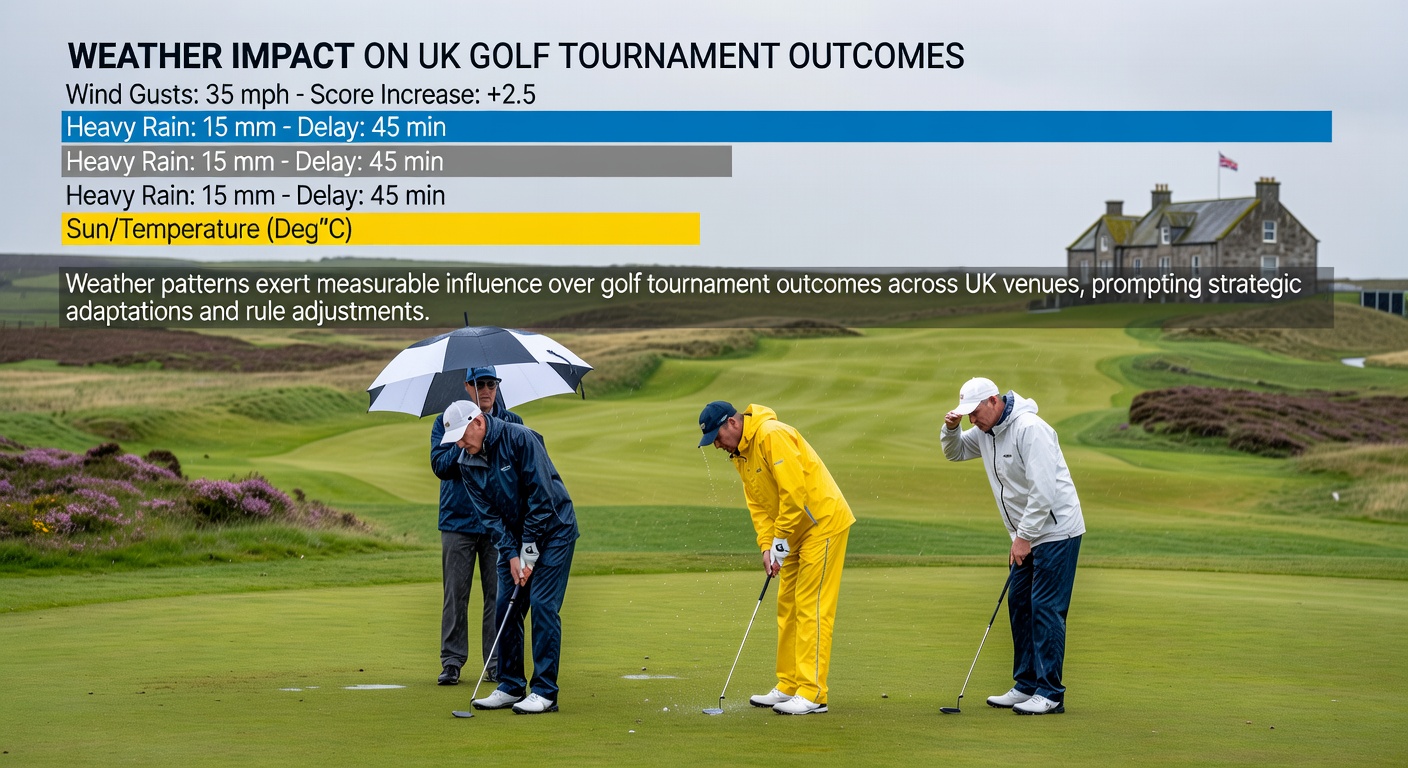
Weather patterns exert measurable influence over golf tournament outcomes across UK venues, prompting data analysts and betting researchers to integrate forecast models with historical course statistics for informed wagering decisions; shifts in wind speed, precipitation levels, and temperature directly alter ball flight, green speeds, and player strategies at courses such as St Andrews and Royal Birkdale. Observers note that these environmental variables create consistent patterns that repeat across seasons, allowing teams to build predictive frameworks rather than relying on general assumptions.
Key Meteorological Variables and Their Course Impacts
Wind remains the dominant factor at many coastal UK layouts where gusts exceeding 25 mph frequently reduce driving distances by 10 to 15 percent while increasing shot dispersion, and researchers have documented how crosswinds at venues like Turnberry shift scoring averages upward by nearly two strokes per round compared to calm conditions. Rain affects turf firmness and ball roll, with data from the past decade showing that sustained rainfall above 5 mm per hour slows greens and favors players who prioritize accuracy over distance. Temperature swings also matter because cooler air increases air density, which slightly reduces carry distance on longer clubs, a pattern confirmed through repeated measurements at events held in early spring versus midsummer.
Historical Course Statistics Meet Modern Forecasting
Analysts combine long-term scoring records from specific holes with real-time meteorological outputs to generate probability distributions for player performance, and this approach has gained traction because raw historical averages alone fail to account for daily conditions. For instance, one dataset covering Open Championship rounds at Royal Liverpool reveals that par-three scoring rises sharply when winds align from the northwest, while approach-shot proximity data improves under drier, firmer conditions. Those who maintain these layered models update them weekly using inputs from numerical weather prediction systems, which now deliver hourly resolution out to 10 days.
Applications in Tournament Preparation and Decision Frameworks
Teams preparing for events scheduled in May 2026 already cross-reference forecast ensembles against archived tournament logs to identify value in specific player matchups and round totals, because certain golfers demonstrate measurable resilience to wind while others show consistent drops in accuracy. Course management data further refines these projections since pin placements published by organizers interact with wind direction to change hole difficulty, a relationship tracked through shot-link systems that record every stroke's starting and ending coordinates. The resulting models produce adjusted expected scores that betting markets have not yet fully incorporated, creating windows where informed positions can be established before public lines adjust.
Regional Differences Across UK Venues
Links-style courses in Scotland and the north of England experience more variable wind patterns than parkland layouts in the Midlands, and statistical comparisons show that scoring variance increases by 18 percent at exposed seaside venues during unsettled periods. Inland sites such as Wentworth record smaller weather-related deviations yet still display clear correlations between overnight rainfall totals and morning scoring averages. Analysts therefore maintain separate regression coefficients for each venue rather than applying a single national adjustment factor.
Data Sources and Model Refinement
Researchers draw on archives maintained by the European Centre for Medium-Range Weather Forecasts to calibrate their inputs, while performance datasets from the European Tour and DP World Tour supply the outcome variables needed for validation. Studies published through academic channels, including work from the University of Edinburgh on microclimate effects at golf facilities, add further granularity by quantifying how local topography modifies regional forecasts. These combined resources allow iterative model updates that reduce forecast error margins over successive tournaments.
Conclusion
The integration of weather forecasts with venue-specific historical statistics has become standard practice among professionals who track UK golf events, because environmental conditions produce repeatable effects on scoring and strategy that raw player rankings overlook. As forecast resolution continues to improve and shot-tracking data expands, the precision of these combined models is expected to rise, supporting more refined assessments of tournament probabilities across the calendar.