Midweek Fixture Congestion Reshapes Goal Expectancy in English Leagues
Written by Noah Schröder · Aug 22, 2026
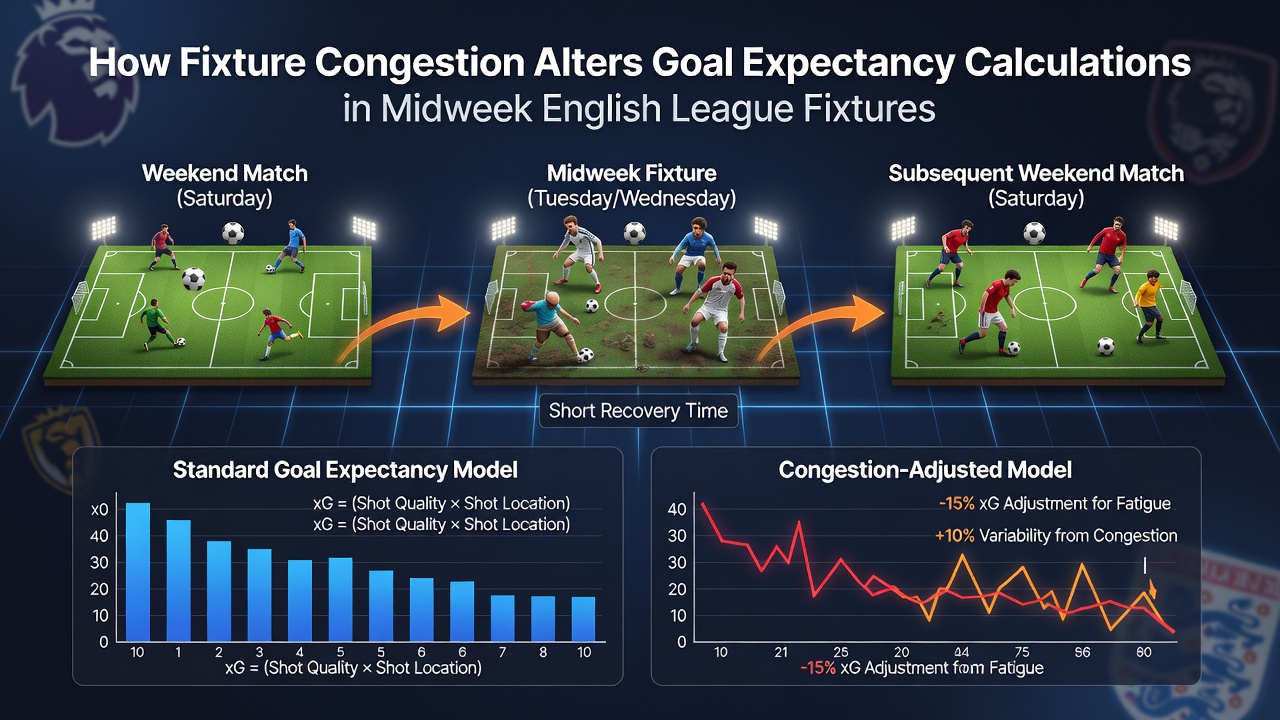
Midweek Fixture Congestion Reshapes Goal Expectancy in English Leagues
English football schedules pack multiple matches into short windows during autumn and winter months, and researchers tracking expected goals have documented consistent drops in scoring projections for teams playing midweek fixtures after weekend games. Data from the Premier League and EFL competitions shows that squads facing three matches in eight days record average expected goals totals that fall between 0.4 and 0.7 below their season norms according to models maintained by performance analytics groups. These adjustments arise because player tracking systems capture reduced high-intensity runs, lower sprint distances, and altered passing accuracy once recovery time shrinks below 72 hours.
Measuring Fatigue Through Performance Metrics
Teams in the Championship and League One encounter the steepest scheduling pressure because they combine domestic cups with league games, and analysts note that central midfielders and full backs display the largest declines in actions per 90 minutes during the second and third matches of congested blocks. Studies compiled by sports science departments at universities in Australia and Canada reveal that muscle glycogen depletion after 48-hour turnarounds correlates with a 12 to 18 percent reduction in shots on target, which directly feeds into revised xG calculations. Models therefore apply multipliers that lower projected goal output for both sides when fixture lists show back-to-back away trips followed by a midweek home game.
League-Specific Patterns in August 2026 Schedules
The 2026/27 season opens with an unusually dense August calendar that includes expanded European qualifiers for promoted clubs, and early data from the first three matchweeks already indicates that sides with additional midweek travel log lower combined expected goals in their subsequent weekend fixtures. Observers tracking these trends point to defensive lines that hold shape longer yet struggle to transition quickly, producing fewer high-quality chances inside the box. External reports from the European Club Association highlight how rotation policies vary by squad depth, with larger Premier League budgets allowing more even distribution of minutes while smaller EFL clubs rely on the same starting XI across three games in nine days.
Adjustments in Predictive Models
Goal expectancy formulas now incorporate recovery-day variables alongside traditional inputs such as recent form and opponent strength, and statisticians update these coefficients after each round of fixtures. One approach multiplies baseline xG by a fatigue factor derived from GPS data collected across multiple seasons, while another method uses machine learning to identify threshold distances that trigger measurable drops in chance creation. Both techniques produce similar outputs when applied to historical midweek results, confirming that total expected goals across a fixture typically sit 8 to 14 percent lower than equivalent weekend matches played after full rest weeks. Industry organizations including the German Football League have published comparative datasets that support these calibration steps for domestic competitions outside England as well.
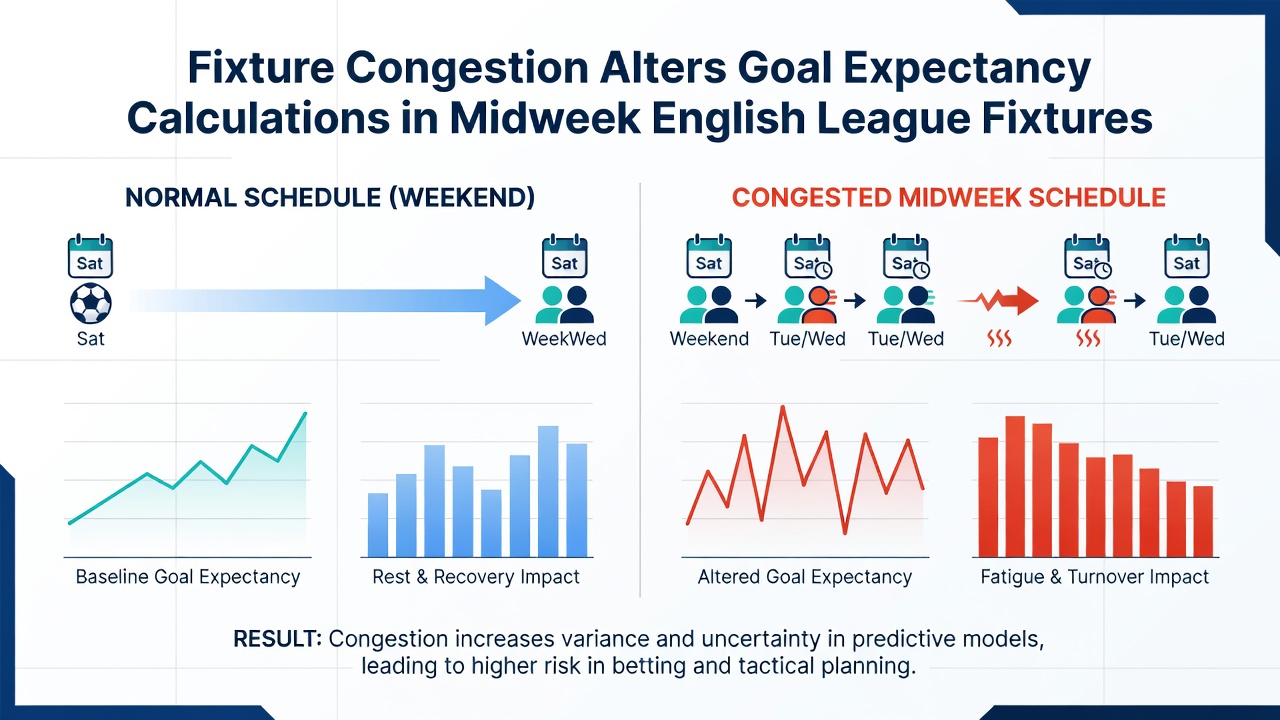
Take the case of a mid-table Championship side that played Saturday, Tuesday, and then Saturday again in late autumn; their combined xG across those three matches fell from an expected 4.8 to an observed 3.9 once fatigue adjustments were applied. Such examples appear regularly in post-season reviews released by performance research units, and they illustrate why bookmakers and analysts maintain separate midweek models rather than relying on standard weekend projections.
Regional Comparisons and Data Sources
Comparisons with leagues that spread fixtures more evenly, such as those in North America, show smaller variance in goal expectancy during condensed periods, which underscores the role of travel distance and pitch conditions in English football. A collaborative paper from Canadian and EU sports institutes examined workload across five European top flights and concluded that English midweek games produce the largest measurable shifts in attacking metrics because of the combination of weather, pitch wear, and fixture density. These findings encourage model builders to treat each league's congestion response as distinct rather than applying uniform corrections across competitions.
Conclusion
Fixture congestion continues to influence how expected goals are calculated for midweek English league matches, and ongoing data collection through 2026 will refine the fatigue multipliers used in current systems. Analysts rely on integrated tracking, recovery metrics, and historical patterns to produce projections that reflect real-world conditions rather than static averages. The result is a more precise set of goal expectancy figures that account for the physical demands placed on players when schedules compress multiple high-stakes games into single weeks.